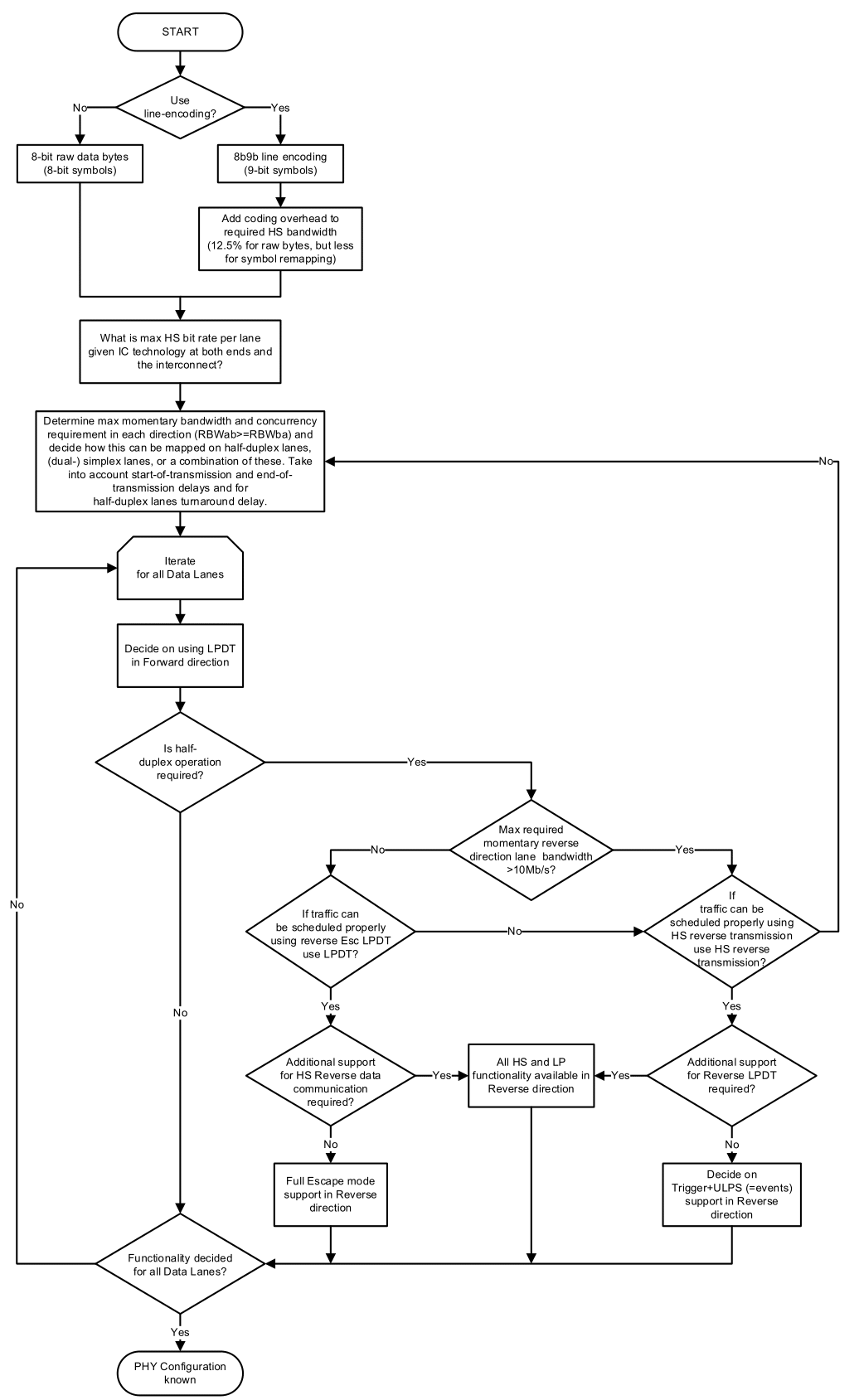
A D-PHY Configuration always includes:
- One Clock Lane, and
- One or more Data Lanes
All Data Lanes must support:
- High-Speed transmission in the Forward Direction
- Escape Mode in the Forward Direction
All lanes may optionally support Alternate Low-Power (ALP) mode.
Types of Data Lanes
There are two main types of Data Lanes:
| Data Lane Type | Directionality | Reverse Communication Support |
|---|---|---|
| Bi-directional | Forward & Reverse | Supports Turnaround and reverse signaling |
| Unidirectional | Forward only | No reverse signaling |
Reverse Communication Options (for Bi-Directional Lanes)
Bi-directional Data Lanes may support one or both of:
- High-Speed Reverse communication
- Low-Power Reverse Escape Mode (with or without LPDT)
Escape Mode and ALP Mode Support
- Escape Mode must be supported in the Forward Direction for:
- ULPS (Ultra-Low Power State)
- Triggers
- Additional Escape Mode or ALP mode features are optional and can be specified per application.
- For Bi-directional Lanes, Escape Mode and ALP behavior may be configured independently in each direction.
Configuration Flexibility
A PHY Configuration offers the following degrees of freedom:
- Number of Data Lanes (single or multiple)
- For each Data Lane: Unidirectional or Bi-directional
- For each Bi-directional Lane: supported reverse communication type(s)
- Escape Mode functionality (per direction per lane)
- ALP mode functionality (per direction per lane)
- Data encoding:
- 8-bit raw data (default), or
- 8b/9b encoded symbols (optional)
Flow Diagram